A Bay Area digital marketing agency for small business.
A digital marketing agency for small business, running the six departments most people buy from four different suppliers. Small team, Walnut Creek, and you talk to the person doing the work. Start with a written plan for $300.
No signup for the checker. No setup fee on anything. Nothing runs until you switch it on.
INTRODUCING
Not just marketing. Your business department too.
Most agencies sell you small business marketing and stop there. I built an AI that runs that marketing every week and the business thinking behind it: what to do next, what it is worth doing, who you are really competing with, and what your own numbers are saying. It works while you are working.
Below are the six things I do. Three of them run on their own once you switch them on. Three of them are me, personally, with a camera or a keyboard. Every panel says which, because an agency that blurs that line is hoping you do not ask.
Open any panel to see what it actually does, and follow its link for the whole page on it.
Hi, I am Sunny. I look after getting you found: local SEO and your Google profile.
Hachi
I handle the weekly work. Blogs, social and email, published whether or not you remember.
Rex
Ads are mine. I watch what you spend against what actually rings the phone.
Sunny
Websites too. Fast on a phone, and written so search engines can read it.
Hachi
Photographs are Beto himself. He shot professionally before any of this.
Rex
Or hand the lot over and we run it together. One person still answers the phone.
01 Local SEO RUNS ITSELF
Be the one they find first.
When somebody in your city types what you sell, you want to be the first name they see. That is the whole job. Every week this checks where you turn up for the words that matter, fixes what is broken on your website, and keeps your Google Business Profile alive with posts and review requests. For most local businesses the Google profile decides more than the website does, so it is treated as the main event rather than an afterthought.
You get the list in plain language: what moved, what did not, and what I did about it.
Eleven workers, publishing on a schedule. You do not write anything and you do not plan anything. The work turns up finished, you tap approve, it goes out.
Blog posts, social posts, short video, carousels, your Google Business Profile, your newsletter, review requests, and the replies to your comments and messages. Each one is a separate worker doing a single job properly.
If you would rather not even do that, switch on autopilot and it publishes on its own. Plenty of people leave it running and check in once a week, on a Friday, for about ten minutes. Nothing is locked: you can change a post, hold one back, or turn the whole thing off from your dashboard.
Nobody stops marketing because they decided it did not matter. They stop because a customer called and a job ran long. This is the part that does not stop.
The honest version: if you are just starting out, do not spend money on Google or social ads yet. You would be paying for attention while the thing the attention lands on is still broken. Fix the first two panels instead, get found for free, and let the customers that brings in pay for the ads.
When you are past that, this is how you go after exactly the person you want: this service, this city, this budget, this week. I build the account, write the campaigns and point them at your service area rather than the whole state.
And I track what happens after the click. Most people running ads can tell you what they spent and not what they got. You will see which clicks turned into phone calls and which words wasted your money, named, every month. The management fee is what you pay me. The ad spend goes to Google on your own card, in your own account, so you can see every dollar and keep the account if we ever part ways.
Two things go wrong with small business websites. It takes too long to open on a phone, so people leave before they see it. Or it opens fine and never actually says what you do, who you do it for, or why anyone should call you instead of the next one down the list.
Built so a search engine can read it and a person standing in a car park on a phone can use it, which turn out to be the same job far more often than people expect. Scoped after the consultation, because a five page site and a fifty page site are not the same work and I would rather price it after seeing yours than guess at you now.
You own it, on your own hosting, and you can take it anywhere.
I shot professionally before any of the marketing work, and it is still the fastest fix for a business whose website is fine but whose pictures are not.
Headshots, your team and your space. Business video for the site and for social. And personal branding: enough pictures of you doing the thing you actually do to last a year of posts, instead of the same cropped photo every time. One-time, priced by the session, no retainer attached to any of it.
Everything above, running as one job instead of five you have to keep track of. Here is the actual order it happens in, every time.
One, I find out where you are now: your site, your profile, your competitors, your numbers. Two, we fix what is broken, because there is no point sending people to something that does not work. Three, we get you found, which is the local SEO and the Google profile. Four, the content starts running weekly and does not stop. Five, once customers are arriving on their own, we add ads to go after more of the ones worth having. Six, it all reports into one dashboard, and then it starts over, because what worked last quarter tells us what to do next quarter.
One person is accountable for the whole loop, and it is me.
The whole thing explained the way I would explain it to you across a table: what runs on its own, what I do myself, and what it costs. If you would rather watch than read, start here.
Gotchu. Lost already? Text me or email me, and skip the rest of the page.
WHO IS BEHIND IT
I owned a small business before I did this.
My name is Batnyagt, and everyone calls me Beto. I spent around five years working in marketing before any of this, but all of it was traditional: print, signage, events, the things you can hold in your hand. Then I owned a small business of my own, and doing its marketing myself is how I found out what this actually costs a business owner. The website, the SEO, the advertising. All of it was hard to understand and all of it took time I did not have.
COVID is what changed it. Everything moved online at once and the traditional side I knew stopped being enough on its own. What I did not expect was how much I would like the digital side. I got genuinely interested doing my own, started studying it properly, and two years later earned my digital marketing certificate. I am certified in Google Ads, I am working towards an MBA now, and I am still studying, because this field rewrites itself every year and anyone who tells you they have finished learning it is already out of date.
Then I built the software, because the businesses I most wanted to help were the ones who could not afford what an agency charges. The SEO checker, the client dashboard and the research pipeline on this site are all mine. I run my own business on the same system I would run yours on, which means when it does not work, I am the first person it fails.
Print, signage, events. Real marketing, none of it online, and none of it much help once everything moved.
02
I owned a small business
Before COVID. Every part of it was ours, including the marketing that nobody teaches you how to do.
03
COVID moved all of it online
What I knew stopped being enough overnight. The digital side turned out to be the part I actually enjoyed.
04
I studied it, got certified, still am
Two years to the digital marketing certificate. Google Ads certified. An MBA in progress, and still learning.
05
Then I built the software
The SEO checker, the client dashboard and the research pipeline on this site. Same problem I had, bigger lever.
My own business, running on the system I would put you on.
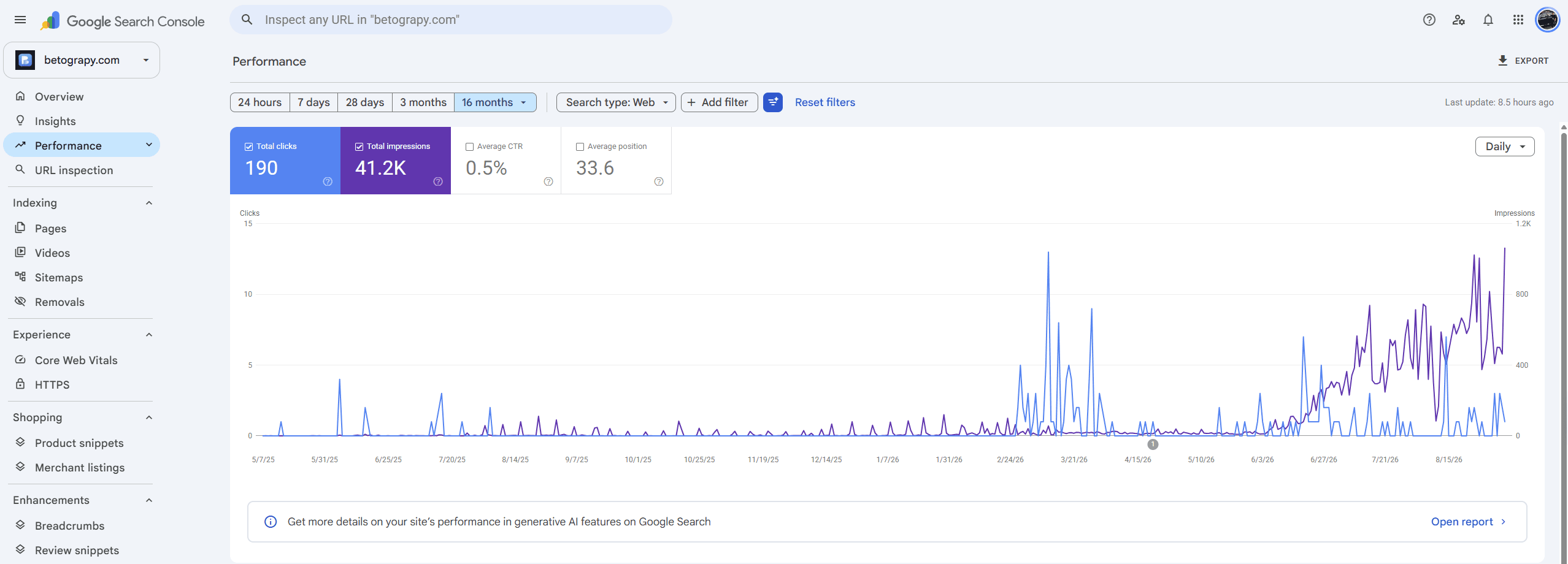
GOOGLE SEARCH CONSOLE41.2Ktimes my pages were shown in searchLast 16 months, from a standing start
LINKEDIN, FACEBOOK, INSTAGRAM, PINTEREST35K+times my posts were seen, in a monthPinterest is most of it, around 30K monthly views. These are impressions, not visits to my site, and anyone showing you a number like this owes you that distinction.
That is the curve I am trying to start for you, and look at where it bends. Nothing for months, then it climbs. That gap is the compounding, and it is why I tell people six months rather than six weeks.
Now the part every agency uses against you. Search Console also reports my average position as 33.6, which sounds like page four. It is not a useful number and neither is anyone else’s. Average position averages the handful of keywords you are actually targeting together with thousands of accidental impressions for phrases you never wanted, so it always looks bad, and it looks bad for everybody.
So here is the number that is actually mine. For “bay area seo company”, the term I most want in the world, I sit at position 14. Page two. Page one is held by agencies with twenty year old domains who sell search for a living, and I am four or five places off joining them. That is a real answer to “how are you doing”, and it is the same answer I would give you about your business rather than a number chosen because it flattered me.
Which is exactly why I do not put a single site-wide number on this page and ask you to be impressed by it. Ask me what I rank for and I will show you the specific keywords, the positions and the dates, and you can decide whether that is worth anything to you. The written case study does that for a client ↗
HOW PEOPLE ACTUALLY START
Nobody switches on all six at once.
Not a price list. This is the actual road, from the day you notice something is wrong to the year everything runs without you. You can get on at any point and stop at any point.
DAY 0
You are here
Something is not working and you cannot see which part. Most owners sit here for a year because every answer costs money before it tells you anything.
costs nothing to admit
SAME HOUR
Run the checker
It reads your live pages and your Google Business Profile and hands you the list. Plenty of people fix it themselves and never hire me, which is a fine outcome.
The whole business, not just the website. The checker only sees your digital side. This needs the inside too, so you answer a questionnaire, about twenty quiet minutes, no call. Roughly thirty pages back, and your first month included.
Usually local SEO and your Google Business Profile first, because that is where a local business gets found. Month to month, cancelled in your own dashboard.
All six departments on, publishing and reporting into one dashboard, with one person accountable for the whole loop. This is the finish line, and most people take a year to get here.
You can stop at any station. Nobody is moved to the next one without asking.
Six months before this looks like much, and anyone promising you month one is selling you something else.
WHERE I WORK
Nine cities, one bridge apart.
Local SEO is the part that genuinely has to be local, so each city gets its own page written for its own market rather than one page with the name swapped.
They do not compete with each other, and that is deliberate. Somebody in Hayward and somebody in Berkeley are not typing the same thing into Google, so each page is aimed at its own search and its own market. Nine pages each winning one city beats one page losing nine.
Pick a part of the Bay and see what is different about it.
b.SERVICE AREASNine city pages
01 / THE EAST BAY
Where I am, and where I started.
Walnut Creek is home. These are suburban markets where people search a service plus a city and then call the first business that looks open and reviewed.
◎
Walnut CreekMy own city. Downtown retail and services, high review expectations
↗
ConcordBigger, more price-led, and a market where showing up on Maps matters most
⌘
PleasantonAffluent and comparison-heavy. People read before they call
02 / OAKLAND, BERKELEY AND SF
Dense, and split into neighbourhoods.
These are not one market each. A business on Telegraph and a business in Elmwood are competing for different people, and treating the city as one audience is the usual mistake.
◎
OaklandNeighbourhood by neighbourhood, with real differences between them
↗
BerkeleyDemand that moves with the campus calendar, not the sales quarter
⌘
San FranciscoThe most competitive, and the one where speed and reviews decide it
03 / SOUTH BAY AND THE BRIDGES
Bigger areas, longer decisions.
Wider service areas and more research before anyone calls. These markets reward a website that answers questions properly, not just a profile that exists.
◎
San JoseLarge and spread out. One profile rarely covers the whole service area
↗
FremontDiverse and word-of-mouth led, with search closing the loop
⌘
HaywardValue-conscious and practical. Clear pricing wins more than polish
Consultations, strategy and full-service programs run nationwide. All service areas ↗
BEFORE YOU ASK
The questions I get every week.
Do I have to buy all six departments?
No, and almost nobody should. Blank means off on every department, so nothing runs until you switch it on. Most people start with two, usually local SEO and the Google Business Profile. Every plan and price is published here ↗
Is there a setup fee?
Not on the consultation, the monthly plans, ads management or photography. Onboarding is you connecting accounts in the dashboard, which takes about twenty minutes. Full-cycle programs are the one exception and are scoped after the consultation. See the pricing page ↗
Who actually does the work?
I do. There is no account manager and no junior staff. I built the checker, the dashboard and the research pipeline on this site, which is why I can tell you where any number came from. Who I am ↗ and what I will not do ↗
How fast does any of it work?
Google Business Profile changes can show inside two weeks. Website SEO is slower: expect three months before rankings move and six before that becomes a reliable number of calls. It compounds, so the sixth month is worth more than the first three put together. Anyone quoting you faster is either lucky or lying. A worked example, with the numbers ↗
Do you work outside the Bay Area?
The local SEO work suits Bay Area businesses best, because knowing the market is most of the job. Consultations, strategy and full-service programs run nationwide. All service areas ↗
What if I already have an agency?
Then the $300 consultation is a second opinion you own outright, and it is priced like one. Several people have used it to work out whether what they are already paying for is working. See what is in the report ↗
Which department should I start with?
Local SEO and your Google Business Profile, almost always, because they decide whether anyone finds you at all. Run the free checker first and it will tell you whether that is true for your business specifically.
What does the whole thing cost?
Every number is published. The consultation is $150, $300 or $500 paid once, depending how deep you want it, and the $300 one includes your first month of AI Auto-Marketing. After that AI Auto-Marketing is $300 a month, one price with everything switched on. Everything else is priced on its own: ads management is $750 or $1,200 a month, photography starts at $249, and web design is scoped once I have seen your site. Nothing here is quoted only on a call. See the full pricing page ↗
Can I see what the report actually looks like?
Yes. The consultation page shows real pages from it, straight out of the generator rather than a mockup, including the market analysis and the 90-day plan. See real pages from a report ↗
Has this worked for anyone?
There is a written case study with the Search Console numbers behind it rather than a testimonial. Read the case study ↗
I would rather just ask a question first.
Text me or email me. It reaches me, not a queue, and I will tell you if I am not the right fit rather than booking a call about it. Other ways to reach me ↗